
A homeless individual makes camp with a bicycle, tarp, and coats on the street next to St. Joseph Diner. Photo by Brittany LeJeune.
As Lafayette recovers from COVID-19 with issues of inflation, wages, and housing costs, non-profits are helping individuals experiencing homelessness on a case-by-case basis. The circumstances they have faced in the last four years are insurmountable. The nonprofit community in Lafayette is taking action and showing up for the homeless.
Catholic Charities of Acadiana operates the largest shelter in Lafayette with enough beds for 160 men, women, children, and veterans to sleep there on any given night of the week. The nonprofit also runs a soup kitchen, hygiene center, home repairs, food bank, and disaster response team. The shelter is one of the few places that offer emergency shelter in Lafayette. Many of the nearby shelters closed during the pandemic and did not reopen.
“There are certainly more people in an experience of homelessness than there are available shelter beds for them,” Ben Broussard, the chief of external affairs at Catholic Charities of Acadiana, said.
Terrance St. Julien oversees the nonprofit organization called Pay it Forward Lending a Helping Hand. The organization is assisting homeless individuals with emergency shelter who have no residence or place to live and are in immediate need of housing.
St. Julien understands the circumstances that are leaving people homeless and in need of assistance. Individuals working for minimum wage are making $900 a month and it is not enough to support themselves. If they can afford to rent an apartment for $600, after they pay the light bill and other utilities, they are left with nothing. There is no way to pay for day care, insurance, gas, or groceries.
Teri Dupuy-Gore, the executive director of The Hub Lafayette, has heard similar stories from many of the friends that she helps at her organization. The focus of The Hub Lafayette is relationships. They want to build relationships with people to empower them to grow and live a more stable life.
Dupuy-Gore considers people paying for an apartment for $700 a month with no refrigerator or stove while others are paying the same price for a fully furnished apartment as “not logistically equal.” The homeless are sleeping on people’s sofas, in dilapidated apartments, living out of their cars or struggling to find a place that is not on the ground.
Catholic Charities of Acadiana cost close to $1.7 million a year to run and there is no local, state, or federal funding that they can rely on to pay their expenses. Funding was taken from the shelters because the homeless were languishing there. The funds were redirected to permanent supportive housing leaving the shelters with no type of revenue.
The most important donors to Catholic Charities of Acadiana are the people who commit to $5, $10, or $20 a month. The willingness to support the organization starts with wanting to help that person on the side of the road. If a thousand people commit to a small monthly donation, the nonprofit could build a foundation for the organization.
The last administration in Lafayette was set on criminalizing homelessness. The nonprofit organizations have hope that with new leadership there may be help for the homeless. Eighty-eight percent of the homeless population in Lafayette are from Acadiana. These are not people from out of state or other locations in Louisiana.
“As a society, as an area, we owe it to our people to have something in place to provide them that last resort care,” Broussard said.
St. Julien recalls one other homeless program like Pay it Forward in Lafayette, but the funding was cut, and the people were left on the street. Even the shelters that are open now charge the homeless to sleep there. The other shelters are first come, first serve.
“You see people asking sometimes for money at the gas station, it’s not necessarily that they want beer or drugs, they are trying to make that $8 or $9 or $10 a day so they can have their money for the shelter,” St. Julien said.
Catholic Charities of Acadiana will find the people who are most vulnerable when they are using their services and assess their needs so that they can find assistance for them. The most vulnerable have high levels of mental illness, substance abuse, or a physical disability that prevent them from having the ability to care for themselves which can lead to them possibly perishing on the street.
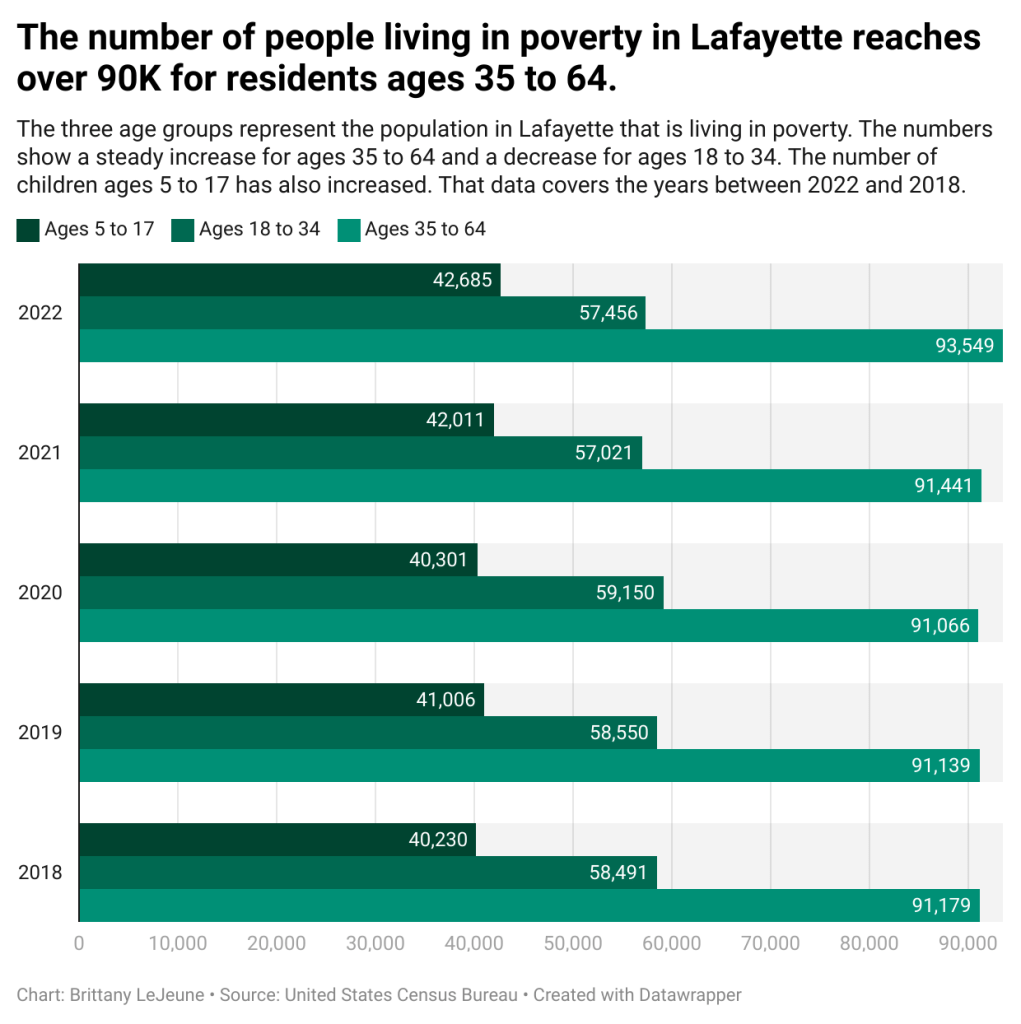
It is common for people to assume that the homeless are responsible for their current situation. Many of the nonprofit workers refer to a common series of events known as the snowball effect that results in homelessness. It is a compounding effect that occurs when someone experiences a hardship preventing them from paying for a house.
This scenario can happen in several different ways. For example, the onset of a serious health problem causes an individual to miss work and accumulate medical bills they cannot afford, leaving them unable to pay for their house. It could be a car wreck, domestic violence, loss of a job, physical injury, or eviction. One problem leads to another, then the person becomes trapped.
“It’s just the reality of everything that’s happening in this world, sometimes it catches you off guard,” Dupuy-Gore said. “You’re not prepared, and you have a medical expense that you didn’t anticipate, or you may have a bill, or you may get a ticket. Things happen in life.”
The organizations commonly hear criticism and judgement. The homeless are labeled as lazy and cast off as bums who just need to get a job. Dupuy-Gore said this has never been the case. It is not that simple. People often assume the homeless do not want to work but this is not the reason people are living on the street.
“You got folks who leave about 6:30 to 7 o’clock in the morning walking toward the bus stop in their work attire,” Broussard said. “We have employed people in our shelter.”
The reason is deep rooted, complicated, and involves a mix of issues. People will often criticize the homeless, but they are not willing to help or take any action to fix the problem. They stand on the street corner and the people who pass by heckle them, ignore them, and refuse to help them and nonprofits such as The Hub Lafayette want them to know that their lives have value.
“We are about a hand up, not a handout,” Dupuy-Gore said.
The Lovewell Center at The Hub Lafayette focuses on self-help classes and employment. The members receive points for the number of hours they work by providing proof with their check stubs. The points are redeemed for products and services in The Lovewell Center.
Members can use the points for non-perishable goods, hygiene products, clothes, shoes, backpacks, laundry, and haircuts. These items range from sleeping bags to undergarments. The Hub Lafayette’s goal is to provide items and services that can offset the cost of more important expenses.
“We encourage you that, if you want x, y, and z, these are the steps that you can take to do that,” Dupuy-Gore said.
Pay it Forward provides people who need emergency shelter a place to stay for two to three weeks while the organization finds them an apartment. St. Julien will interview these people and make a video of their story that he can share with the community. The nonprofit is called “Pay it Forward” because it is an opportunity for people in the community to help.
“When I see you in six months, I want to hear that you are still doing great,” St. Julien said. “We don’t do handouts and say just here. That’s not us.”
Pay it Forward is trying to find options to pay for expenses according to the person’s income. St. Julien can find housing that is affordable by adjusting the rent according to their income. He has worked with people who are paying $150 a month. St. Julien is interviewing a grandmother and her granddaughter that are victims of domestic violence and in need of housing later today.
Pay it Forward will continue its mission, just as The Hub Lafayette and Catholic Charities of Acadiana will as well. The future is uncertain and unpredictable. The need for assistance and change is urgent and people are noticing it.
 Brittany LeJeune
Leave a comment